
Table of Contents
Introduction
Look, I’m going to be honest with you—owning a home in Barrie is different than owning one in, say, Burlington or Oakville. Our winters hit harder. Our spring thaws create chaos. And don’t even get me started on what happens to a deck that doesn’t get stained regularly around here.
After working with Barrie homeowners for over 12 years, I’ve seen the same pattern repeat itself: a homeowner skips “just one year” of maintenance, and suddenly they’re calling us about a $5,000 water damage problem that could’ve been prevented with $20 worth of caulking.
Here’s the thing—your home is probably your most significant investment. And Barrie’s climate? It’s basically trying to destroy that investment 24/7. The freeze-thaw cycles, the heavy snow, the temperature swings from -25°C to +30°C… It’s a lot. But with the proper maintenance schedule, you can protect your home and actually save money in the long run.
What makes this guide different:
I’m not going to give you a generic maintenance checklist copied from a home improvement magazine based in California. This is specifically designed for Barrie and Simcoe County. Every task is timed to our weather patterns. Every cost estimate reflects local pricing. And every recommendation comes from actually working on homes in Holly, East Bayfield, South Shore, and every other Barrie neighborhood.
Whether you live in a 1970s bungalow that needs some TLC or a brand-new build in East Bayfield, this checklist will help you stay ahead of problems.
Let’s dive in.
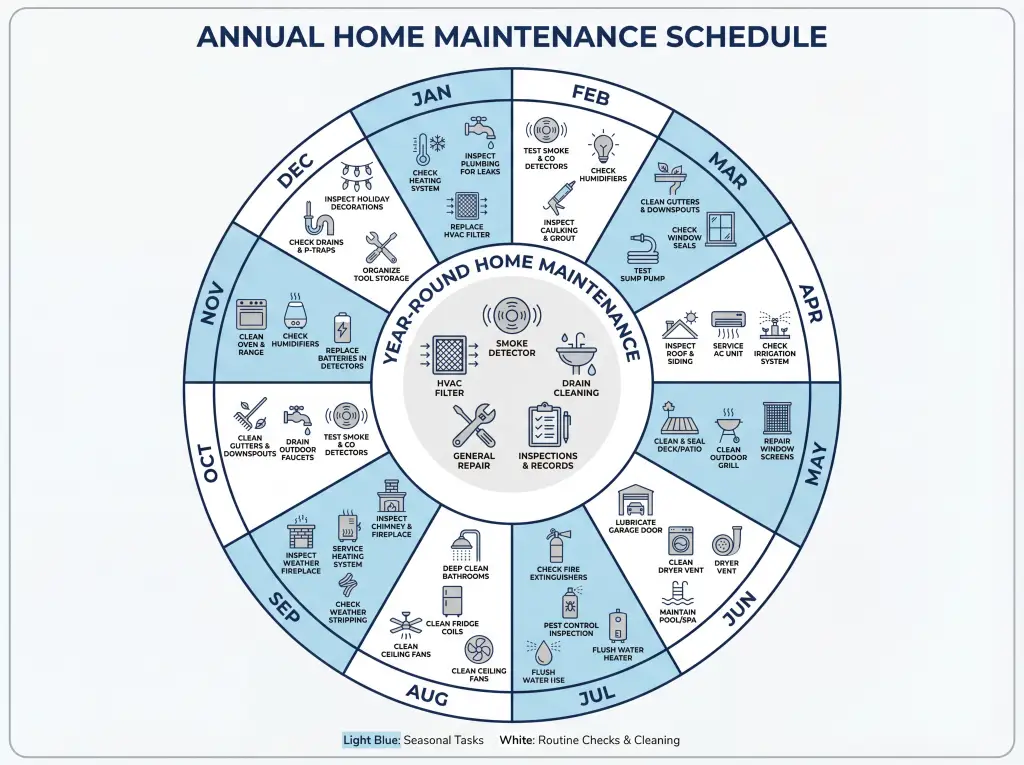
Monthly Maintenance Tasks (Year-Round)
Set a reminder on your phone for the first Saturday of each month. These tasks take about 30-45 minutes in total and are the foundation of good home maintenance. Think of them as your monthly health check for your house.
HVAC Filter Check and Replacement
Real talk: I can’t tell you how many service calls we’ve gotten where the “broken” furnace just had a filter so clogged you couldn’t see through it. It’s like trying to breathe through a pillow.
Check your furnace and AC filters every month. In Barrie, with our long heating season and dusty springs, filters get dirty fast. A clogged filter doesn’t just waste energy—it can actually damage your furnace or AC unit.
How to check: Pull out the filter and hold it up to a light. If you can’t see through it, it’s toast. Replace it.
Time: 5 minutes | Cost: $10-30/filter | DIY: Absolutely
Pro tip from experience: Buy filters in bulk at Home Depot when they’re on sale. For most Barrie homes, you’ll need about 12 filters per year. Stash them in your utility room, and you’ll never forget.
Authority source: According to Energy Star, a dirty filter can increase energy consumption by 15% and significantly shorten your HVAC system’s lifespan.
Test Smoke and Carbon Monoxide Detectors
This one’s non-negotiable. Period.
Every month, press the test button on each detector. That’s it. Takes 30 seconds per detector. And in Barrie, where our furnaces run from October through April, a working CO detector is literally life-saving.
What to do:
- Test monthly: Press the button
- Replace batteries: Twice a year (I do it when clocks change)
- Replace units: Every 10 years (write the install date on the back)
Time: 10 minutes | Cost: $10-20/year for batteries | DIY: Yes
I’ve heard too many close-call stories. Don’t be the person who says, “I meant to change that battery.”
Clean Kitchen and Bathroom Drains
This is one of those things that seems unnecessary until you’re standing in ankle-deep water in your shower, wondering how this happened.
The monthly drain trick:
- Pour ½ cup of baking soda down the drain
- Follow with ½ cup of vinegar
- Let it sit and fizz for 30 minutes
- Flush with hot water
This prevents the buildup that leads to slow drains and, eventually, expensive plumber calls.
Time: 10 minutes per drain | Cost: About $5 | DIY: Yes
When to call a pro: If your drains are already backing up, no amount of baking soda will fix it. We offer plumbing fixture services and can clear stubborn clogs properly.
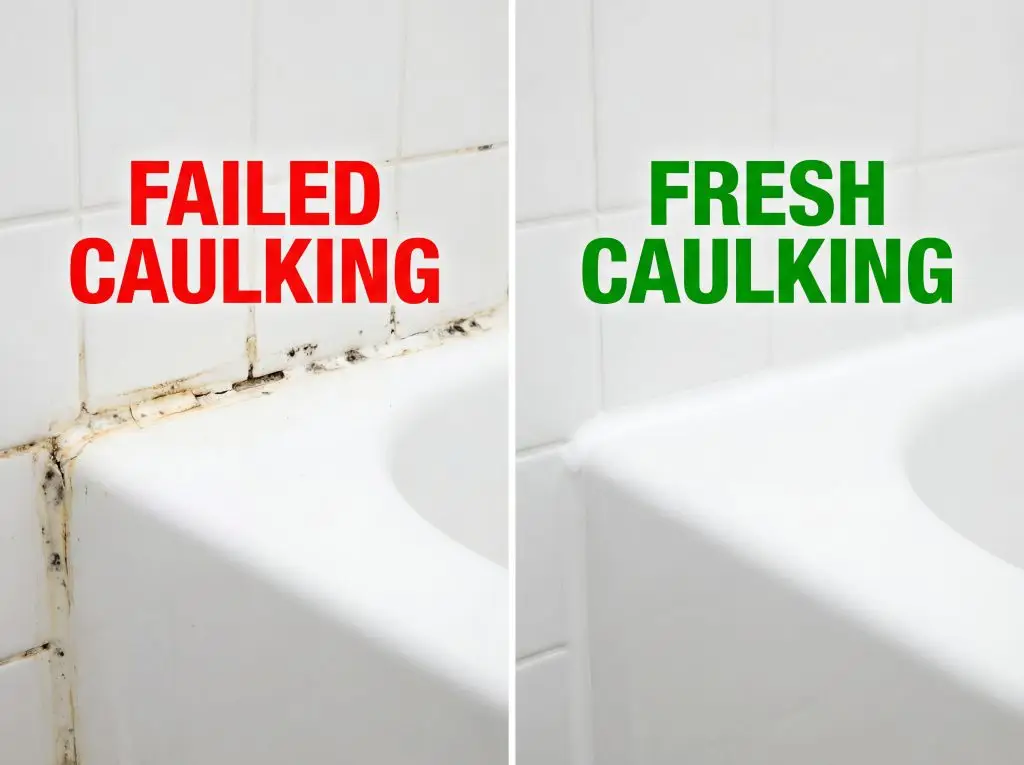
Check Caulking Around Tubs, Showers, and Sinks
Run your finger along all the caulk lines in your bathrooms and kitchen. You’re looking for:
- Gaps or cracks
- Black spots (that’s mold, friend)
- Areas where the caulk has pulled away from the surface
Barrie’s temperature swings make caulk expand and contract more than in milder climates. What lasts 10 years in Toronto might only last 3-5 years here.
Small gaps? Grab a $5 tube of caulk from Canadian Tire and fix it yourself. Significant failures or mold everywhere? That’s when you call someone like us. Proper bathroom caulking costs $100-300 but prevents thousands in water damage and mold remediation.
Time: 5 minutes to inspect | Cost: Free to check, $50-150 to fix | DIY: Inspection yes, repair maybe
Inspect Visible Plumbing for Leaks
Once a month, grab a flashlight and look under every sink in your house. Check around toilets—Peek at your water heater.
What you’re looking for:
- Water stains or puddles (obvious)
- Rust or corrosion (less obvious but essential)
- Dripping faucets (annoying AND expensive)
- Running toilets (sounds like constant water flow)
Here’s a fun fact that’ll motivate you: A running toilet wastes about 200 gallons of water per day. At Barrie water rates, that’s roughly $50/month down the drain. Most toilet repairs cost $100-200 and literally pay for themselves immediately.
Time: 10 minutes | Cost: Free to check | DIY: Yes
Test Garage Door Safety Features
This is important, especially if you have kids or pets. Modern garage doors have safety features that prevent them from closing on someone or something.
The 2×4 test: Place a board under your open garage door and press the close button. The door should reverse when it hits the board.
If it doesn’t reverse? Stop using the door immediately and call a garage door professional. This isn’t one to DIY—garage door springs and mechanisms can seriously hurt you.
Time: 5 minutes | Cost: Free to test | DIY: Test yes, repair NO
Quick Visual Check of Gutters and Downspouts
Just walk around your house once a month and look up. You’re not climbing on the roof (we’ll do deep cleaning seasonally), just checking for obvious problems:
- Gutters sagging or pulling away
- Downspouts disconnected
- Water stains on the siding below the gutters
- Visible debris piling up
Monthly visual checks catch problems early. Complete gutter cleaning should be done twice yearly (see seasonal maintenance below).
Time: 5 minutes | Cost: Free | DIY: Yes
Run Water in Unused Drains
Got a basement bathroom you never use? The guest bathroom that sits empty? Utility sink gathering dust?
Run water in every unused drain for 30 seconds monthly. This keeps the P-trap (the curved pipe under the drain) filled with water, which prevents sewer gases from rising into your home.
Trust me, you do NOT want to learn this lesson the hard way. The smell is… memorable.
Time: 2 minutes | Cost: Free | DIY: Yes
Check for Pest Entry Points
Walk your home’s exterior looking for gaps, cracks, and potential entry points for mice, insects, and other uninvited guests. Barrie’s cold winters drive critters indoors, so prevention is way easier than dealing with an infestation.
Look for:
- Gaps around pipes, wires, or vents entering your home
- Foundation cracks
- Gaps under doors
- Torn window screens
Seal small gaps with caulk or expanding foam ($5-15 at the hardware store). For larger structural issues or active infestations, call a pro.
Time: 10 minutes | Cost: Free to check | DIY: Prevention yes, removal no
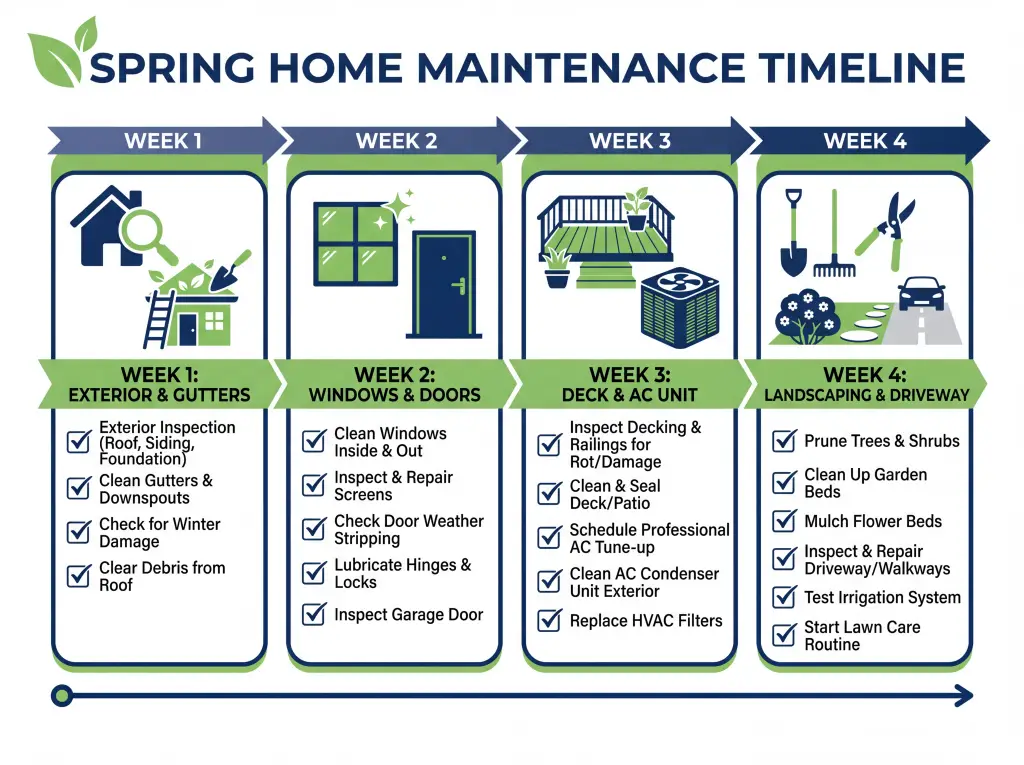
Spring Maintenance Checklist (March-May)
Spring in Barrie is when winter damage reveals itself. This is your busiest maintenance season, but it’s also when you prevent the most significant problems. Set aside a couple of weekends in April/May to knock out these tasks.
The Big Post-Winter Exterior Walkthrough
Grab a notepad and walk around your entire house on a nice, dry day in April. You’re doing detective work here, looking for what winter did to your home.
Start with your roof (from the ground—no climbing yet):
- Missing or damaged shingles
- Damaged flashing around vents, chimneys, and skylights
- Granules collecting in gutters (means your shingles are getting old)
- Ice dam damage from those brutal February storms
Check your siding:
- Cracks, warping, or loose boards
- Paint peeling or bubbling
- Caulking failures around windows and doors
- Water stains (these tell a story)
Inspect your foundation:
- New cracks? Mark them with tape and date them so you can monitor
- White powdery stuff (efflorescence—indicates moisture issues)
- Soil erosion near the foundation
- Any settling or movement
Examine your deck thoroughly:
- Loose or split boards (safety hazard)
- Wobbly railings (also safety)
- Popped nails or screws sticking up
- Gray weathering (means it needs staining soon)
Time: 1-2 hours | Cost: Free (repairs vary widely) | DIY: Inspection, yes, repairs depend
What I usually find: Most Barrie homes have at least a few winter casualties. Don’t panic—that’s normal. Prioritize safety issues first (loose deck boards, structural concerns), then tackle cosmetic stuff.
When to call us: Roof issues, significant siding damage, or structural concerns need professional eyes. We offer spring inspection services and can handle everything from deck restoration to exterior painting touch-ups.
External authority: The Canadian Home Builders’ Association recommends bi-annual home inspections, with spring being the most critical in climates like ours.
Clean and Inspect Gutters and Downspouts
This is one of the most crucial spring tasks. I cannot stress this enough. Clogged gutters during the spring thaw can cause:
- Foundation flooding
- Basement water damage
- Ice dam formation (if it freezes again)
- Fascia and soffit rot
- Siding damage
What to do:
- Remove all leaves, sticks, and crud (get in there with gloves and a bucket)
- Flush gutters with a hose—check that water flows freely
- Ensure downspouts point AWAY from foundation (minimum 6 feet)
- Check for sagging or loose sections
- Look for rust or holes
Time: 2-4 hours, depending on house size | Cost: $150-300 if you hire someone | DIY: Yes, if single-story and you’re comfortable on ladders
Safety reality check: Falls from ladders send people to Royal Victoria Hospital’s ER every spring. If you have a two-story home, hire someone. It’s not worth the risk.
Barrie-specific note: Our spring thaw creates MASSIVE runoff. A clogged gutter means all that water goes exactly where you don’t want it—against your foundation or into your basement. I’ve seen $15,000 foundation repairs that could’ve been prevented with $200 gutter cleaning.
Test and Seal Window and Door Gaps
Open every single window and door in your house. Yes, all of them. Check for:
- Drafts (hold a lighter near the edges and watch for flame movement)
- Difficulty opening or closing
- Visible gaps around frames
- Weatherstripping that’s cracked, brittle, or missing
The fix:
- Replace worn weatherstripping ($2-5 per window/door at any hardware store)
- Re-caulk exterior gaps with quality exterior caulk
- Adjust doors that don’t close properly
This isn’t just about comfort—proper sealing can reduce your heating/cooling costs by 10-20%. In Barrie, that’s real money.
Time: 1-2 hours | Cost: $10-50 in materials | DIY: Absolutely
Local reality: Barrie’s freeze/thaw cycles are tough on window caulking. In Toronto, exterior caulking might last 10 years. Here? You’re looking at 3-5 years max. It’s just physics.
Get Your AC Serviced (Before You Need It)
Do NOT wait until the first 30°C day in June to discover your AC doesn’t work. Call an HVAC tech in April or early May for annual servicing.
What they’ll do:
- Check refrigerant levels
- Clean coils (dirt reduces efficiency by 20-30%)
- Inspect electrical connections
- Test thermostat accuracy
- Check for leaks
- Verify proper operation
Annual AC servicing extends equipment life by 5-10 years and keeps your unit running efficiently. It typically costs $150-250, which is much cheaper than emergency repair or replacement.
Time: 1-2 hours (professional) | Cost: $150-250 | DIY: No—needs licensed tech
Authority source: Natural Resources Canada recommends annual HVAC maintenance to maintain energy efficiency and prevent breakdowns.
Deck Inspection and Spring Cleaning
Your deck took a beating this winter. Snow weight, freeze/thaw cycles, ice scraping… It’s been through hell. Spring is assessment time.
Detailed deck check:
- Walk every square foot—feel for soft, spongy wood (that’s rot)
- Check every board for splits, cracks, and loose connections
- Grab the railings and shake them (they shouldn’t move)
- Look for popped nails or protruding screws (sand them down or hammer them in)
- Check underneath for rot, insect damage, and structural issues
Clean your deck:
- Sweep off all debris
- Use a deck cleaner product ($15-30) and a stiff brush
- Rinse thoroughly
- Let dry 2-3 days completely
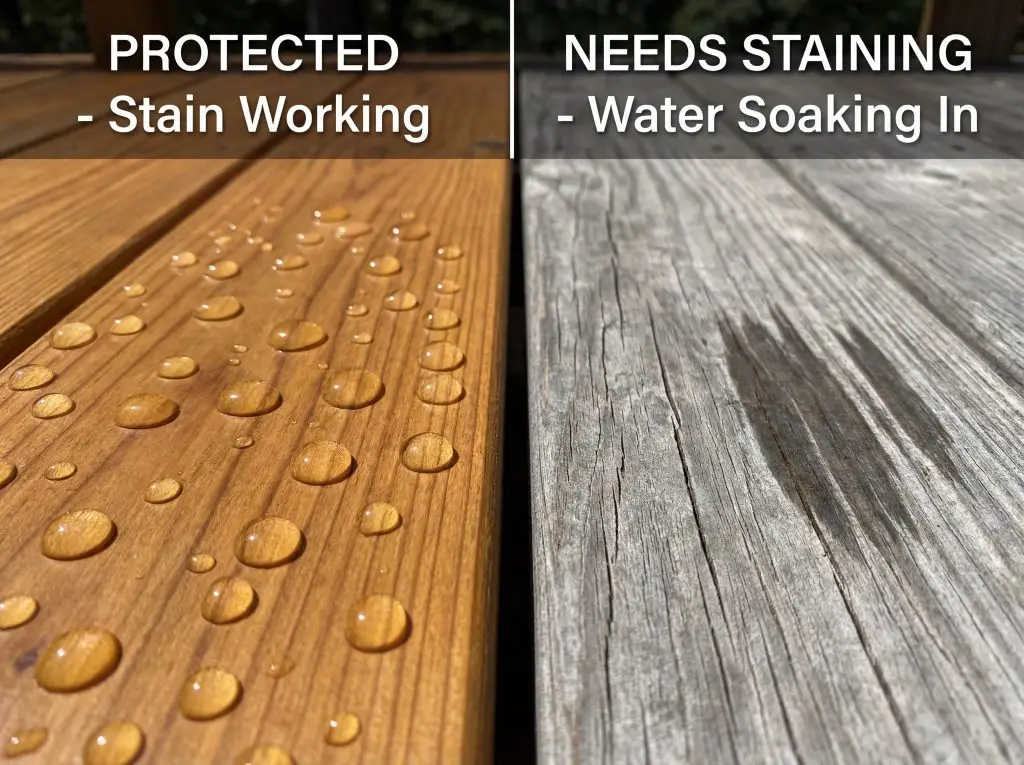
After it dries, do the water test:
- Sprinkle water on your deck boards
- Does it bead up and stay on the surface? Your stain is still protecting.
- Does it soak right in? Time to restain.
Time: 2-4 hours for cleaning | Cost: $50 for cleaner and supplies | DIY: Yes for cleaning
The staining question: If your deck looks gray, dry, or fails the water test, it needs staining. In Barrie’s climate, decks typically need staining every 2-3 years (not the 4-5 years you’ll see quoted for milder climates).
DIY vs pro staining: Cleaning is definitely DIY-able. Staining? You can do it yourself if you have time, patience, and good weather luck. But professional staining lasts longer because we have better equipment and frankly, more experience. We’ve stained hundreds of decks in Barrie. Check out our deck staining and restoration services—we guarantee our work.
Pressure Wash Siding (If Needed)
If your siding shows mold, mildew, or significant dirt buildup, spring is the time to clean. Pressure washing:
- Removes organic growth before it damages siding
- Extends paint life
- Improves curb appeal dramatically
- Reveals any damage that needs repair
Important warning: Pressure washing looks easy on YouTube. In reality, you can:
- Blast water behind siding (causing hidden moisture damage)
- Strip paint off
- Damage wood, vinyl, or stucco
- Hurt yourself (those things generate severe pressure)
Cost: $300-600 for professional work, $100-200 for equipment rental
My recommendation: Unless you’ve pressure-washed before and know what you’re doing, hire someone. We include pressure washing prep with our exterior painting services, and we have the right equipment and technique.
Time: 2-4 hours | DIY: Maybe, but carefully
Landscape and Garden Bed Cleanup
This is more about home protection than aesthetics (though it helps with that too):
- Clear debris from beds and the foundation perimeter
- Cut back dead perennials
- Edge beds so they’re defined
- Add fresh mulch (3 inches deep—creates a moisture barrier)
- Check grading around the foundation
That last one is critical: Your yard should slope AWAY from your foundation—6 inches of drop over 10 feet. If water pools against your foundation, you’re asking for basement moisture problems.
Time: 4-8 hours depending on property size | Cost: $100-200 for mulch | DIY: Yes
Driveway and Walkway Inspection
Winter was harsh on your pavement. Look for:
- Cracks wider than ¼ inch
- Spalling (surface flaking—typical with salt damage)
- Potholes or sunken sections
- Edge crumbling
Asphalt driveways:
- Fill cracks immediately with asphalt crack filler
- Plan to seal every 2-3 years ($150-300 DIY, $300-600 professional)
- Minor repairs now prevent full resurfacing ($3,000-8,000)
Concrete driveways/walkways:
- Seal cracks with concrete crack filler
- Consider applying a concrete sealer to resist salt damage
- Monitor for heaving or settling
Time: 1 hour for inspection, varies for repairs | Cost: $50-200 for DIY repairs | DIY: Small repairs yes, major work no
Attic Check for Winter Damage
Grab a flashlight and go into your attic on a sunny day. What you’re looking for:
- Water stains on rafters or insulation (roof leak evidence)
- Daylight visible through the roof boards (definitely bad)
- Lingering frost or condensation in early spring (ventilation issue)
- Mold growth or musty smell (moisture problem)
- Pest evidence (droppings, nests, chewed insulation)
Spring thaw reveals winter roof leaks. Finding them now, before summer rains, prevents escalating damage.
Time: 30 minutes | Cost: Free to inspect | DIY: Yes
If you find problems: Small roof leaks become significant, expensive issues fast. Don’t wait for roof repairs.
Test Your Sump Pump
If you have a sump pump (and many Barrie basements do), spring thaw is when it works hardest. Test it:
- Pour a 5-gallon bucket of water into the sump pit
- The pump should activate automatically
- Water should discharge outside, away from the foundation
- The pump should shut off once the water level drops
If your pump doesn’t activate, makes weird noises, or runs continuously, replace it immediately. Spring thaw + broken sump pump = flooded basement.
Replacement schedule: Every 7-10 years, or sooner if it’s acting up
Cost: $300-800 for replacement | Emergency cost of failure: $5,000-20,000 in flood damage
Time: 10 minutes | DIY: Yes for testing, maybe for replacement
Summer Maintenance Checklist (June-August)
Summer is project season in Barrie. Long days, warm weather, and (usually) predictable conditions make it ideal for exterior work. This is when you tackle the big stuff.
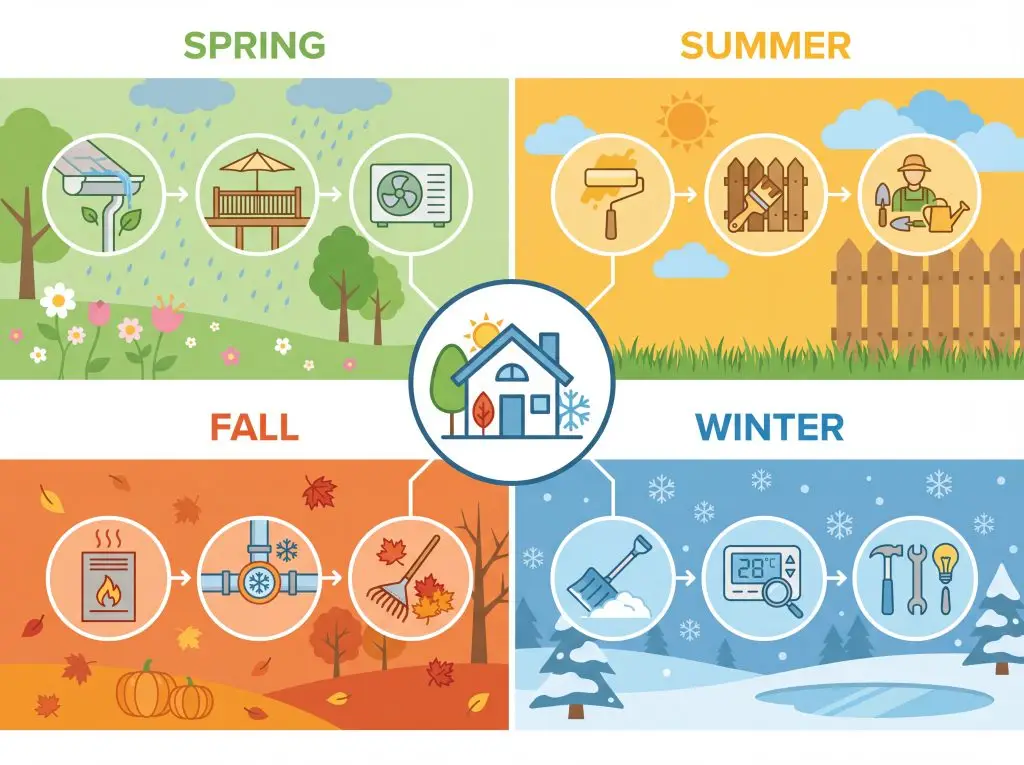
Deck Staining Season (If Needed)
If your spring inspection showed weathering or failed the water test, summer is staining time. But timing matters:
Wait for the right conditions:
-
- 2-3 consecutive dry days before staining
-
- Temperatures between 15-30°C
-
- Low humidity
-
- No rain forecast for 24-48 hours after
Why summer is ideal: Spring weather is too unpredictable. Fall’s window is short. Winter is… winter. Summer gives you multiple opportunities to hit the perfect weather window.
Time commitment: 1-3 days, including prep, application, and drying
Cost: $300-800 DIY (stain + supplies), $800-2,500 professional, depending on deck size
DIY considerations:
-
- Do you have the time? (Proper prep takes as long as staining)
-
- Do you have the equipment? (Pump sprayer, brushes, sanders)
-
- Is the weather cooperating?
-
- Can you commit to 2-3 full days?
Professional advantages:
-
- Better equipment = more even application
-
- Proper prep (cleaning, sanding, repairs) = longer-lasting results
-
- Experience with Ontario weather and products
-
- Warranty on work (we guarantee ours for 3 years)
I’m not saying you can’t DIY deck staining—plenty of people do. But after staining hundreds of Barrie decks, we’ve learned the tricks that make stain last 3-4 years instead of 2—your call.
Learn more about our deck staining and restoration process.
Time: 1-3 days | Cost: $300-2,500 | DIY: Maybe
Exterior Painting Projects
Summer is the ONLY reliable time for exterior painting in Barrie. Paint needs:
-
- Temps above 10°C (ideally 15-25°C)
-
- No rain for 24-48 hours before and after
-
- Low humidity for proper drying
-
- Multiple consecutive good days
Barrie reality check: We typically get this kind of weather June through August, and that’s it. Miss your summer window, and you’re waiting until next year.
Why Barrie homes need repainting more often: Our harsh winters, UV exposure, and temperature extremes mean exterior paint typically lasts 7-10 years here vs. 10-15 years in milder parts of Ontario. It’s just the reality of living here.
DIY or hire a pro?
Single-story home, one or two walls? DIY could work.
Whole house, two stories, lots of prep work needed? Hire someone.
Here’s the thing about exterior painting: prep work is 60-70% of the project. Scraping, sanding, priming, caulking—this is what makes paint last. Skip it, and you’ll be repainting in 2-3 years.
We’ve redone too many rushed DIY paint jobs. Check out our exterior painting service—we do it right the first time.
Time: Varies by house size | Cost: $3,500-10,000 professional | DIY: Not recommended for the whole house
Have maintenance questions? Call us at (705) 910-0106 or send us a message. We’re always happy to help Barrie homeowners protect their investment.
Monthly AC Maintenance Through Summer
Once a month, while you’re running AC:
Clean the outdoor unit:
- Turn off the power at the breaker
- Remove debris (leaves, grass clippings, cottonwood fluff)
- Trim back vegetation 2 feet minimum
- Gently rinse condenser coils with a garden hose
- Check that the unit is level (settling causes problems)
- Turn power back on
Listen for problems:
- Grinding or squealing noises
- Clicking that won’t stop
- Unusual vibrations
Dirty condenser coils reduce efficiency by 20-30%. Five minutes of monthly cleaning saves money on your electric bill.
Time: 30 minutes monthly | Cost: Free | DIY: Yes
Summer Caulking Projects
Summer heat makes caulk pliable and easy to work with. Re-caulk any gaps found during spring inspection:
Priority areas:
- Window frames (exterior)
- Door frames
- Where siding meets trim
- Around outdoor electrical outlets/fixtures
- Any gaps where different materials meet
Caulk quality matters: Spend $8-12 per tube on quality caulk, not $2-4 on cheap stuff. Good caulk should last 5-10 years. In Barrie? Expect 3-5 years, even with quality caulk, due to our temperature extremes.
Time: 1-2 hours | Cost: $20-50 in materials | DIY: Absolutely
Authority source: CMHC (Canada Mortgage and Housing Corporation) emphasizes proper caulking as essential moisture protection in Canadian climates.
Garage Door Maintenance
Your garage door is used multiple times a day but rarely maintained. Summer is tune-up time:
Inspection:
- Watch it open and close—smooth movement or jerky?
- Listen for unusual grinding, squealing, or scraping noises
- Check cables for fraying (serious safety issue)
- Inspect tracks for bends or obstructions
- Test safety reverse (2×4 board test from the monthly checklist)
Lubrication:
- Use silicone spray lubricant (not WD-40)
- Lubricate hinges, rollers, tracks, and springs
- Wipe away excess
Time: 30 minutes | Cost: $10 for lubricant | DIY: Inspection and lubrication, yes, repairs NO
Critical warning: Never, ever attempt to adjust or repair garage door springs yourself. They’re under extreme tension and can cause serious injury or death. Spring repair costs $150-300 and is worth every penny for safety.
Deep Clean Dryer Vent
House fires aren’t funny, and clogged dryer vents are responsible for about 15,000 of them annually in North America. Summer is deep cleaning time:
Full vent cleaning:
- Unplug/turn off the dryer
- Disconnect the vent hose from the back of the dryer
- Clean lint from the dryer’s exhaust port
- Clean entire length of vent hose (shop vac or vent brush)
- Go outside and clean the exterior vent cover
- Reconnect everything securely
Signs your vent needs cleaning:
- Clothes are taking longer to dry
- The dryer is getting very hot
- Burning smell
- Lint is visible around the door seal
Time: 30 minutes to 1 hour | Cost: $100-150 professional, free DIY | DIY: Yes if accessible
If your vent runs a long distance or has bends, consider professional cleaning every 2-3 years.
Roof Inspection from Ground
You don’t need to climb on your roof—that’s dangerous. Use binoculars instead:
What to check:
- Missing or damaged shingles
- Lifted/curled shingles
- Damaged flashing around vents, chimney, and skylights
- Moss or algae growth
- Sagging areas (structural concern)
- Granule loss (check gutters—lots of granules means aging shingles)
When to call a pro: If you spot problems, get a professional roof inspection ($200-$400). Minor issues now prevent $5,000-15,000 emergency repairs later.
Roof lifespan in Barrie: Asphalt shingles typically last 15-25 years, depending on quality. Our freeze/thaw cycles and UV exposure mean Barrie roofs age on the shorter end of that range.
Time: 15 minutes | Cost: Free for binocular inspection | DIY: Yes for inspection, never for work
Check the Foundation for Settling
Walk your home’s perimeter, checking the foundation:
- Compare cracks to spring photos (are they getting bigger?)
- Look for new cracks
- Check for separation between the foundation and the siding
- Look for bowing or bulging
- Watch for carpenter ant activity (they love foundation gaps)
Hairline cracks (<¼ inch) are usually regular foundation settling. Wider cracks, cracks that change with seasons, or horizontal cracks can indicate problems.
Document everything: Take photos with dates. This creates a timeline in case issues develop.
Time: 20 minutes | Cost: Free | DIY: Yes
If concerned: Foundation issues aren’t DIY territory. Get a structural engineer’s assessment ($500-1,000) for peace of mind.
Fall Maintenance Checklist (September-November)
Fall is your last chance to prep for Barrie’s brutal winter. Skip these tasks at your peril—winter is coming, and it doesn’t care if you’re ready.
The Critical Final Gutter Cleaning
This is even more important than spring cleaning. Why? Clogged gutters in winter can cause ice dams, leading to roof leaks and costly repairs.
Wait until most leaves have fallen (late October in Barrie, early November if it’s a warm fall), then clean thoroughly:
- Remove ALL debris
- Flush the hose to verify proper flow
- Check downspout discharge—still directing water away?
- Inspect for damage while you’re up there
- Consider gutter guards if you’re tired of cleaning
Gutter guards worth it? Maybe. Quality guards cost $8-15 per linear foot installed. They reduce cleaning frequency but don’t eliminate it. Compare that to $150-300 twice-yearly professional cleaning. Your call.
Time: 2-4 hours | Cost: $150-300 professional | DIY: If single-story and comfortable
I’ll repeat my spring warning: ladder falls are serious. Two-story home? Just hire someone.
Winterize Outdoor Faucets and Irrigation
This 30-minute task prevents $1,000-$ 5,000 in burst-pipe damage. Do NOT skip it:
For every outdoor faucet:
- Find and turn off the interior shut-off valve
- Go outside and open the outdoor faucet fully
- Let it drain completely
- Leave outdoor faucet OPEN all winter (yes, really)
- Disconnect and store all hoses
For irrigation systems:
- Blow out all lines with compressed air ($100-150 if you hire someone)
- Drain system completely
- Insulate the backflow preventer with a foam cover
What happens if you skip this: Water left in pipes freezes, expands, and cracks the pipe. Come spring, you turn on the faucet and water sprays everywhere—insurance claim time. Don’t be that person.
Time: 30 minutes | Cost: Free for faucets, $100-150 for irrigation blowout | DIY: Faucets, yes, irrigation, maybe
Furnace Service (Before You Need Heat)
Schedule this for September or early October, before the rush. Don’t wait until the first cold night when every HVAC company in Barrie is slammed with emergency calls.
Professional furnace service includes:
- Clean burners and heat exchangers
- Check and test all safety controls
- Calibrate thermostat
- Inspect venting and flue for blockages
- Test for carbon monoxide leaks
- Check gas pressure and connections
- Verify proper operation
Why annual service matters: Your furnace will run almost continuously from October through April (that’s like 6-7 months in Barrie). Annual maintenance:
- Maintains efficiency (saves 10-15% on heating)
- Prevents mid-winter breakdowns
- Extends equipment life by 5-10 years
- Keeps your family safe (CO leak detection)
Time: 1-2 hours (professional) | Cost: $150-250 | DIY: No—needs licensed technician
Our Barrie winters are unforgiving. A working furnace isn’t optional. Get it serviced.
Authority link: Natural Resources Canada recommends annual furnace maintenance for safety and efficiency.
Weatherstrip All Doors and Windows
Before winter, check and replace weather stripping everywhere:
Detection method:
- Hold a lit lighter or incense stick near the door/window edges
- Watch for flame movement or smoke being pulled/pushed
- Mark anywhere you detect drafts
Replace worn weather stripping:
- It’s cheap ($2-5 per door/window)
- Installation is straightforward (usually adhesive or tack strip)
- Results are immediate
Weatherstripping can reduce heating costs by 10-20%. In Barrie, with our long heating season, that’s serious money.
Time: 1-2 hours total | Cost: $20-50 | DIY: Absolutely
Attic Insulation Check
Your attic insulation is your first line of defense against Barrie’s cold winters. The Ontario building code recommends R-50 (about 16 inches of blown insulation).
Measure yours:
- Less than 10 inches? You’re losing 20-30% on heating—add insulation
- 10-16 inches? Adequate, could be better
- 16+ inches? Excellent, you’re good.
Adding insulation costs: $1.50-3.00 per square foot, but pays for itself in 5-7 years through energy savings.
Time: 30 minutes to inspect | Cost: Free to check, $1,500-3,000 to upgrade | DIY: Inspection yes, installation maybe
External authority: CMHC provides detailed insulation guidelines for Canadian climates.
Chimney and Fireplace Service
If you burn wood, have your chimney swept and inspected annually before using it. Creosote buildup causes chimney fires—I’ve seen the aftermath, and it’s devastating.
Even if you have a gas fireplace, you still need an annual inspection for:
- Proper venting
- Gas connections
- Safety sensors
- Glass seal integrity
Time: 2 hours (professional) | Cost: $150-300 | DIY: No—needs certified chimney sweep
Reverse Ceiling Fan Directions
I bet 90% of people forget this simple trick that actually works.
The science: Warm air rises. In winter, you want to push that warm air back down from the ceiling. Most ceiling fans have a direction switch.
How to do it:
- Look up at your fan
- Find the direction switch (usually on the motor housing)
- Flip it so the fan spins clockwise when looking up
- Run the fan on low speed
This can improve heating efficiency by 10-15% because you’re redistributing warm air instead of letting it pool at the ceiling.
Time: 5 minutes per fan | Cost: Free | DIY: Yes
Replace Smoke and CO Detector Batteries
When clocks fall back in November, replace all detector batteries. Make it a routine:
- Clocks fall back = new batteries in detectors
- Test each unit after installing batteries
- Replace any detector over 10 years old (write install date on back)
Your furnace is about to run 24/7 for the next six months. A working CO detector is literally life-saving.
Time: 20 minutes | Cost: $10-20 | DIY: Yes
Trim Trees and Branches Near the House
Barrie ice storms can snap branches. Objects near your house become missiles. Fall is pruning time:
What to remove:
- Dead or diseased branches
- Branches within 6-10 feet of the house or the roof
- Branches overhanging the roof
- Weak or damaged limbs
Time: 2-4 hours for small trees | Cost: $300-500+ for professional tree service | DIY: Small trees, ye;, large trees, NO
Don’t be a hero: Large trees or branches over your roof require certified arborists with proper equipment and insurance. Tree work injuries are serious.
Store Outdoor Furniture and Equipment
Clean and store:
- Patio furniture (cushions especially)
- BBQ grill (clean it first)
- Planters (empty and store or bring tender plants inside)
- Garden hoses (drain and coil)
- Pool equipment (if applicable)
- Outdoor decorations
Items left outside are subject to freeze/thaw damage. Your $1,500 patio set will last 15 years if stored properly, vs. 5-7 years if left out.
Time: 1-2 hours | Cost: Free | DIY: Yes
Snow Removal Equipment Check
Whether you have a snowblower or just shovels, get ready:
Snowblower maintenance:
- Change oil (or check level)
- Replace the spark plug
- Stock up on shear pins
- Test start and operation
- Stabilize fuel if storing with gas
Shovel inventory:
- You need at least 2 (one will break)
- Ergonomic designs save your back
- Keep one by each door
Ice melt prep:
- Stock up before the first snow (prices spike)
- Store in a dry location
- Consider pet-safe/concrete-safe options
Time: 1 hour | Cost: $50-150 for service | DIY: Basic maintenance, yes
Pro tip: Service your snowblower in the fall when shops aren’t busy. Waiting until after the first snow means competing with everyone else.
Winter Maintenance Checklist (December-February)
Winter maintenance is about vigilance and managing problems. It’s also perfect for planning spring projects and tackling interior work.
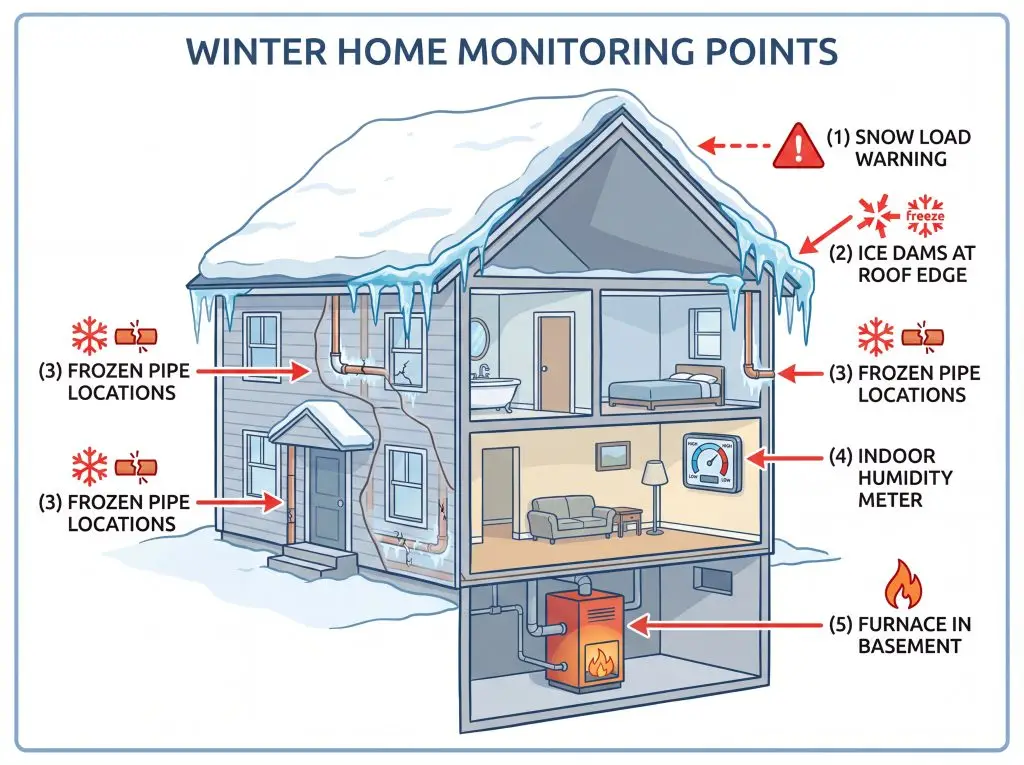
Monitor Snow Load on Roof
After heavy snowfalls (30+ cm), keep an eye on your roof:
Warning signs:
- Sagging gutters
- Doors that stick or pop open
- Cracks appearing in drywall or plaster
- Unusual roof noises
When to remove snow: If the accumulation exceeds 60 cm or you notice sagging. Barrie can get 200-250 cm total annually, so monitor after back-to-back storms.
Critical: Never attempt to remove roof snow yourself. It’s hazardous. Hire professionals with proper equipment, insurance, and experience.
Time: Visual checks are quick | Cost: $200-500 for professional snow removal | DIY: Monitoring yes, removal NO
Ice Dam Watch
Ice dams form when heat escapes from your attic, melts snow on your roof, and refreezes at the eaves. This creates a dam that backs up water under the shingles.
Prevention:
- Keep attic cold (proper insulation and ventilation)
- Remove snow from the roof edges after big storms
- Install heat cables on problem areas ($200-400 installed)
If ice dams form, call professionals for safe removal. Chipping ice yourself damages shingles. Specialized steam removal is safer but requires expertise and equipment.
Time: Ongoing monitoring | Cost: $100-500 depending on severity | DIY: Prevention yes, removal no
External authority: The Institute for Catastrophic Loss Reduction (ICLR) has excellent resources on ice dam prevention for Canadian homes.
Monitor Indoor Humidity
Barrie winters mean heated, dry indoor air. Use a hygrometer ($15-25) to monitor:
Ideal range: 30-40% relative humidity
Too low (<30%):
- Dry skin, bloody noses
- Respiratory irritation
- Static electricity everywhere
- Wood furniture cracking
- Solution: Use a humidifier
Too high (>50%):
- Condensation on windows
- Potential mold growth
- Musty smell
- Solution: Improve ventilation, use a dehumidifier
Window condensation is your warning sign. If you see frost or ice buildup on interior windows, your humidity is too high.
Time: Daily quick checks | Cost: $20 for hygrometer | DIY: Yes
Check for Ice Buildup in Gutters
From the ground, look for large icicles hanging from gutters. Some icicles are normal. Huge, thick ones mean potential ice dams forming.
Don’t try to knock down large icicles yourself—you can damage gutters or hurt yourself. Let them melt naturally, or call a professional if they indicate serious ice-dam problems.
Time: 2 minutes (visual from ground) | Cost: Free to monitor | DIY: Watching yes, removal no
Keep Walkways and Driveways Clear
This is both a safety issue and a Barrie bylaw requirement. You’re supposed to clear walkways within 24 hours of snowfall.
Best practices:
- Shovel soon after the snow stops (easier than waiting)
- Use ice melt sparingly (it damages concrete and grass)
- Shovel to bare pavement if possible
- Create paths for drainage when it melts
DIY vs. service: Snow removal contracts for residential driveways typically run $300-800 per season, depending on size and frequency. Worth it if you travel, have physical limitations, or hate shoveling.
Time: 15-30 minutes per snowfall | Cost: Salt/ice melt $20-40/season, snow service $300-800/season | DIY: Your choice
Prevent Frozen Pipes
Frozen pipes that burst cause catastrophic damage. Prevention is everything:
Pipes at risk:
- Exterior walls (especially bathrooms and kitchens)
- Unheated garages
- Crawl spaces
- Under kitchen/bathroom cabinets on outside walls
Prevention tactics:
- Let faucets drip during extreme cold (-20°C and below)
- Open cabinet doors to let warm air circulate
- Keep garage doors closed when possible
- Never set the thermostat below 15°C, even when away
If the pipes freeze, call a plumber immediately. DIY thawing can cause pipes to burst from uneven heating.
Time: Daily awareness | Cost: Free prevention, $1,000+ if they burst | DIY: Prevention yes, fixing NO
Check Furnace Filter Weekly
In peak winter (December-February), your furnace runs almost constantly. Check filters weekly:
Why weekly? A furnace running 20+ hours daily in -25°C weather goes through filters fast. A clogged filter:
- Makes the furnace work harder
- Increases energy costs by 15-20%
- It can cause system failure when you need heat most
Replace filters when you can’t see through them—often every 2-3 weeks in deep winter.
Time: 2 minutes weekly | Cost: $10-30 per filter | DIY: Yes
Stock up on filters so you always have spares. Running out in February when it’s -30°C is not fun.
Plan Spring and Summer Projects
Winter is perfect for:
- Getting quotes for spring work (deck staining, painting, renovations)
- Booking contractors early (we fill up by March)
- Researching project ideas
- Budgeting for maintenance costs
- Creating project timelines
Why book early? Barrie handypersons and contractors get slammed from March through October. Booking in winter means:
- Priority scheduling
- Sometimes, there are better rates (less demand)
- First pick of available time slots
If you’re thinking about deck restoration, exterior painting, or kitchen renovation for next year, winter is planning time.
Time: Varies | Cost: Free to plan | DIY: Planning phase definitely
Interior Winter Projects
Can’t do exterior work? Winter is ideal for indoor projects:
Good winter projects:
- Interior painting (we do this year-round)
- Drywall repairs (especially after winter settling)
- Basement finishing
- Bathroom updates
- Kitchen renovations
- Flooring installation
Why winter works for the interior? No heat or humidity concerns. No insects flying in open doors. Contractors often have more availability.
Time: Varies by project | Cost: Varies by project | DIY: Some projects, yes, major renovations hire a pro
Check the Attic for Frost
On frigid days (-20°C or colder), peek into your attic with a flashlight:
What you’re looking for:
- Frost buildup on rafters or roof sheathing
- Ice crystals on insulation
- Excessive moisture
What frost means: Warm air is escaping from your living space into the attic. This:
- Wastes energy
- It can cause mold in the spring when the frost melts
- May contribute to ice dams
Solutions:
- Seal air leaks from below (around lights, bathroom fans, chimneys)
- Improve attic insulation
- Add attic ventilation if needed
A professional energy audit ($300-500) identifies all the air leaks you’re missing.
Time: 10 minutes monthly | Cost: Free to check | DIY: Yes for checking
Annual Maintenance Tasks (Every 1-3 Years)
These are the big-ticket items that keep your home in top shape in the long term.
Professional Whole-House Inspection
When: Every 3-5 years, or before major renovations, or if buying/selling
A professional inspector checks:
- Roof condition and remaining life
- Structural integrity
- Electrical system safety and capacity
- Plumbing system condition
- HVAC performance and efficiency
- Insulation adequacy
- Foundation condition
- And about 100 other things
Why every 3-5 years? Catches developing problems early. A $500 inspection can prevent $5,000-50,000 in emergency repairs. It’s insurance for your investment.
Time: 2-4 hours | Cost: $400-600 | DIY: No—needs certified inspector
Deck Restoration and Staining
We’ve talked about this throughout, but it’s worth repeating: In Barrie, decks need staining every 2-3 years.
Every 2-3 years:
- Thoroughly clean with deck cleaner
- Sand rough or weathered areas
- Repair any damaged boards
- Apply two coats of quality stain/sealer
Every 10-15 years:
- Expect to replace some boards
- Check structural posts and beams
- Consider complete restoration or rebuild
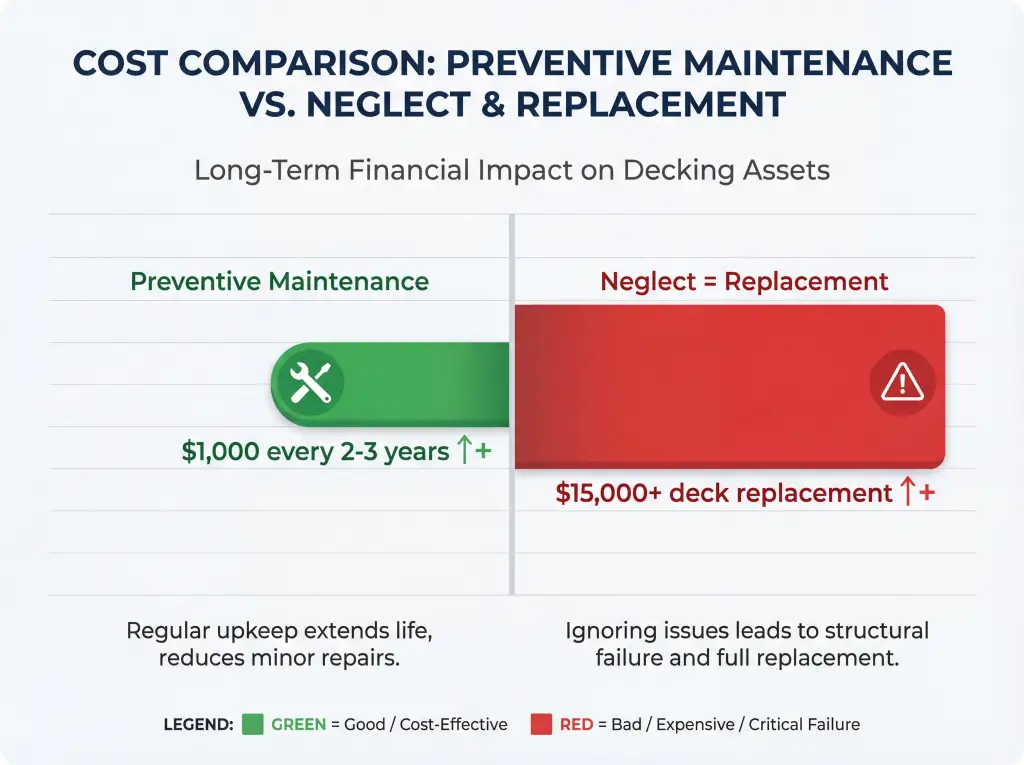
The math: A $30,000 deck needs roughly $1,000 maintenance every 2-3 years, or it needs $10,000+ replacement after 10-12 years of neglect. Which sounds better?
We’ve been staining Barrie decks for 12+ years. Our work lasts because we use the right products and proper techniques. Check out our deck services.
Time: 2-3 days for the complete job | Cost: $800-2,500, depending on size | DIY: Maybe, but results vary
Major Appliance Servicing
Your appliances are expensive. Maintain them:
Refrigerator (every 1-2 years):
- Clean condenser coils
- Check door seals
- Test defrost cycle
- Verify proper temperature
Dishwasher (every 1-2 years):
- Clean filters and spray arms
- Inspect seals and gaskets
- Check for leaks
Washer/Dryer (every 1-2 years):
- Inspect hoses (replace every 5 years)
- Clean the dryer vent thoroughly
- Check the washer for leaks
- Verify proper leveling
Why service matters: Appliances that are serviced regularly last 12-15 years. Neglected ones last 8-10 years. A $150 service call can prevent an $800 repair or premature $2,000 replacement.
We offer appliance installation and basic servicing as part of our handyperson services.
Time: 1-2 hours per appliance | Cost: $100-200 per appliance | DIY: Some tasks, yes, complex issues no
Exterior Paint Inspection and Touch-Ups
Every year, walk around your house checking the paint condition.n Every 7-10 years: Full exterior repainting
Annual inspection catches:
- Peeling or bubbling spots
- Exposed wood (needs immediate attention)
- Fading areas
- Caulking failures
Touch up problem areas immediately. Exposed wood in Barrie’s climate deteriorates fast.
Signs you have completed repainting:
- Widespread chalking (rub the siding—white powder comes off)
- Peeling in multiple areas
- Wood grain visible through paint
- Significant fading or discoloration
Barrie timeline: Expect to repaint every 7-10 years due to our harsh weather (vs. 10-15 years in milder Ontario regions). It’s just the Cost of living here.
Professional exterior painting includes extensive prep work—that’s what makes paint last.
Time: Annual inspection 30 minutes, full repaint varies | Cost: Touch-ups $50-200, full repaint $3,500-10,000 | DIY: Touch-ups whole full house no
Septic System Maintenance (If Applicable)
If you’re on septic (some rural Barrie areas, Bradford, Collingwood):
Every 3-5 years: Pump your tan.k Every 3 years: Professional inspection
Signs of problems:
- Slow drains throughout the house
- Gurgling sounds
- Sewage odors
- Wet spots or lush grass over the drain field
Cost of neglect: Septic system replacement runs $15,000-30,000. Regular $400 pumping prevents that nightmare.
Time: 2-3 hours (professional) | Cost: $300-500 pumping, $200-400 inspection | DIY: No—needs licensed septic professional
External authority: The Ontario Ministry of the Environment provides maintenance guidelines.
Water Heater Maintenance
What you can do:
- Drain 5-10 gallons from the bottom valve quarterly (removes sediment)
- Check temperature setting (120°F/49°C is ideal)
- Test the pressure relief valve annually
What professionals do:
- Complete tank flush
- Anode rod inspection and replacement (extends tank life 5+ years)
- All safety systems check
- Efficiency evaluation
Water heaters last 8-12 years with maintenance vs. 6-8 years without. Annual professional service ($100-150) is smart insurance.
Time: 30 minutes DIY quarterly, 1 hour professional annually | Cost: $100-150 professional | DIY: Partial
Window and Door Seal Inspection
Every 2-3 years: Full inspection and caulking refresh
Barrie’s temperature swings are brutal on seals. Walk around your home checking:
- All caulking around windows and doors
- Weatherstrippingstripping condition
- Gaps or failures
- Frame condition
Re-caulk as needed. Good exterior caulk should last 5-10 years in mild climates. In Barrie? 3-5 years is more realistic.
Old windows (15+ years)? Modern windows can save 20-30% on energy costs, plus dramatically improve comfort. Sometimes replacement makes more financial sense than constant repair.
Time: 2-3 hours for full house check | Cost: $50 DIY caulking, $200-500 professional | DIY: Yes
Foundation Waterproofing Check
Every 5 years or if moisture problems develop:
Look for:
- Basement dampness or water stains
- Musty or moldy smell
- Efflorescence (white crusty deposits on walls)
- Cracks with water seepage
- Bowing or bulging foundation walls
Waterproofing options (not DIY):
- Interior sealing: $3,000-5,000
- Exterior excavation and sealing: $8,000-15,000+
- French drain installation: $3,000-8,000
Don’t ignore basement moisture. It leads to mold, structural damage, reduced home value, and health problems. Address it early before it escalates.
Time: 30 minutes to inspect | Cost: $200-400 professional inspection, $3,000-15,000+ waterproofing | DIY: Inspection maybe, waterproofing NO
Barrie-Specific Maintenance Realities
Living in Barrie means accepting certain maintenance realities. Our climate demands more frequent attention than homes in Toronto, Ottawa, or Windsor experience.
Why Barrie is Tougher on Homes Than the GTA
Temperature extremes: We regularly swing from -25°C to +30°C (that’s a 55-degree range). Toronto rarely hits -20°C. Every degree matters—materials expand and contract constantly here.
More freeze/thaw cycles: Barrie averages 40-50 freeze/thaw cycles per winter. Each cycle damages pavement, foundations, caulking, and paint. GTA sees maybe 30 cycles.
Lake effect considerations: While we don’t get the crazy lake effect like Collingwood or Owen Sound, we still average 200-250 cm of snow annually—significantly more than southern Ontario.
Higher UV exposure: Less lake moderation means more direct sun, which fades and degrades paint and stain faster.
The result? Everything wears out faster here. It’s not bad luck—it’s physics.
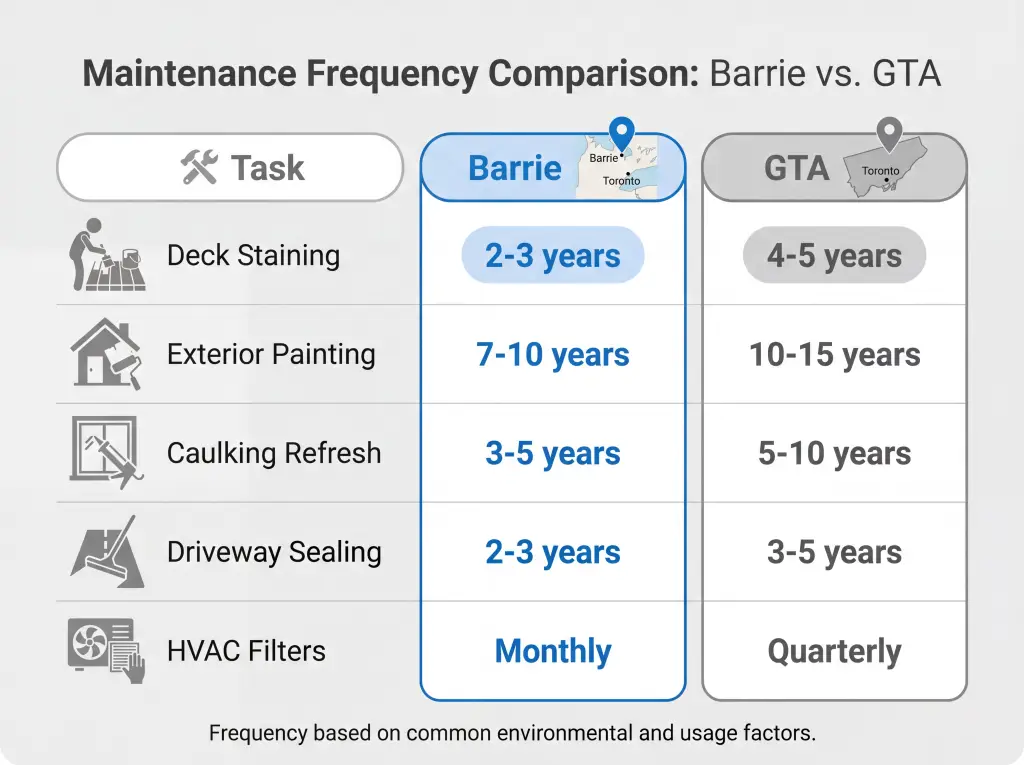
Maintenance Frequency Differences
Here’s what needs doing more often in Barrie compared to milder Ontario regions:
Deck staining: Barrie 2-3 years | GTA 4-5 years | 40-50% more often Exterior painting: Barrie 7-10 years | GTA 10-15 years | 30-40% more often Caulking refresh: Barrie 3-5 years | GTA 5-10 years | 50% more often Driveway sealing: Barrie 2-3 years | GTA 3-5 years | 30-40% more often HVAC filters: Barrie Monthly | GTA Quarterly | 300% more often
This isn’t a criticism of Barrie—I love living here. But homeowners need realistic expectations. Budget accordingly.
Neighborhood-Specific Considerations
Different Barrie neighborhoods have different challenges:
Waterfront areas (South Shore, Big Bay Point):
- More wind exposure = faster paint and stain deterioration
- Higher humidity = more caulking and siding issues
- Premium decking materials are highly recommended
- Expect maintenance on the more frequent end of the range
Older neighborhoods (Holly, Allandale, Little Lake):
- Homes built 1960s-80s need more attention
- Original windows and insulation are often inadequate
- Watch for outdated wiring and plumbing
- Foundation and structural issues are more common
- More frequent monitoring is recommended
New developments (East Bayfield, Cundles East, Painswick North):
- Builder-grade materials often need upgrades
- House settling in the first 2-3 years requires monitoring
- Landscaping settling affects drainage
- Caulking failures are common in years 2-5
- Don’t assume “new” means “maintenance-free.”
Established areas (Georgian Drive, Ardagh Bluffs):
- Mix of ages and conditions
- Larger lots often mean more maintenance
- Mature trees bring benefits and maintenance needs
- Varied housing stock means varied maintenance schedules
We serve all of Barrie and understand each neighborhood’s quirks.
When to Call a Professional vs. DIY
I’m not here to scare you away from DIY. Plenty of maintenance tasks are totally doable. But some things? Leave them to the pros.
You should DIY when:
- The task is straightforward and safe
- You have the proper tools and knowledge
- Failure won’t cause significant damage or safety issues
- No permits required
- You have time to do it right
Call a professional for:
- Electrical work (dangerous + code requirements + insurance issues)
- Gas work (illegal without a license, potentially lethal)
- Roofing (serious fall hazard)
- Structural modifications (permits + engineering required)
- HVAC (requires licensing and specialized tools)
- High ladder work (anything above the second story)
- Foundation work (specialized knowledge required)
- Major plumbing (beyond simple fixture replacement)
The gray area:
- Deck staining: DIY is possible, but professional results last longer
- Interior painting: DIY friendly, but prep work matters
- Drywall repair: Simple patches DIY, large areas hire a pro
- Appliance installation: Depends on complexity and utilities involved
Our team is licensed, insured, WSIB cleared, and has 12+ years of Barrie-specific experience. We’ve seen what works here and what fails. From simple TV mounting to complete kitchen renovations, we handle projects correctly.
Authority reference: The Technical Standards and Safety Authority (TSSA) regulates gas and electrical work in Ontario—homeowner DIY has limits.
Maintenance Budget Planning and ROI
Let’s talk money. Maintenance costs money, yes. But neglecting maintenance costs way more.
How Much Should You Budget Annually?
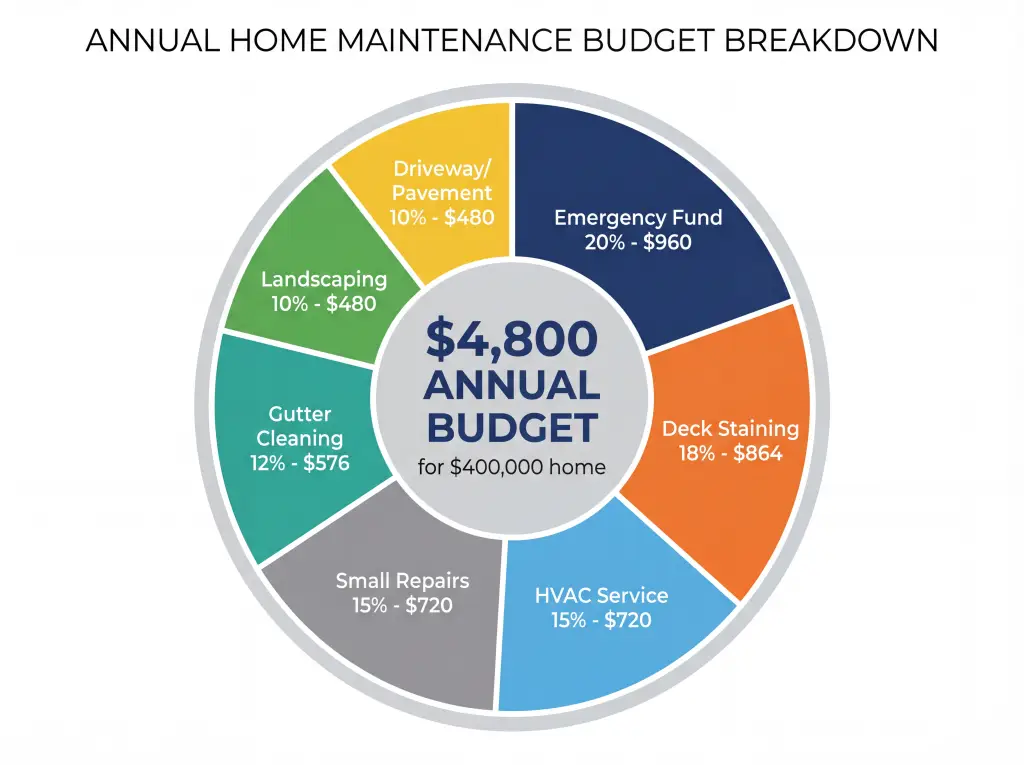
General rule: 1-3% of your home’s value per year
$300,000 home: $3,000-9,000/year $500,000 home: $5,000-15,000/year $700,000 home: $7,000-21,000/year
Why such a range?
- 1%: New homes (0-10 years old) with minimal needs
- 2%: Typical homes (10-30 years) with standard maintenance
- 3%+: Older homes (30+ years) requiring more frequent repairs
These numbers include both routine maintenance and occasional bigger projects. Not every year will hit the average, but over time, this is realistic.
Sample Annual Costs for Barrie Homes
Minimal maintenance plan (mostly DIY):
- HVAC service (furnace + AC): $400
- Gutter cleaning (2x/year, DIY): $0
- Filters, supplies, minor repairs: $300-500
- Total: $700-900/year
Basic maintenance plan (DIY + some professional):
- HVAC service: $400
- Gutter cleaning (professional 2x): $300-400
- Deck cleaning: $100-200 DIY or $300-500 pro
- Filters, caulking, small repairs: $300-500
- Total: $1,100-2,000/year
Standard maintenance plan (recommended):
- HVAC service: $400
- Gutter cleaning (professional): $300-400
- Deck staining (amortized): $400/year (every 2-3 years)
- Seasonal landscaping: $300-600
- Minor repairs and supplies: $400-600
- Total: $1,800-2,400/year
Comprehensive maintenance plan:
- All of the above: $1,800-2,400
- Exterior painting (amortized): $625/year ($5,000 every 8 years)
- Driveway sealing (amortized): $135/year ($400 every 3 years)
- Appliance servicing: $200-400
- Professional services as needed: $500-1,000
- Total: $3,260-4,560/year
These are averages. Some years you’ll spend less—others you’ll pay more for (roof replacement, deck rebuild, furnace replacement). Plan accordingly.
Return on Investment: Preventive Maintenance
Deck staining ($1,000 every 2-3 years):
- Prevents: $15,000-30,000 deck replacement (delayed 10+ years)
- ROI: 15:1 to 30:1
- Payback period: Immediate (every year you delay costs more)
Annual HVAC service ($400):
- Saves: 10-15% on energy bills ($150-300/year)
- Prevents: $2,000-5,000 emergency repairs
- ROI: Pays for itself immediately
- Bonus: Equipment lasts 5-10 years longer
Gutter cleaning ($300-400, twice yearly):
- Prevents: $5,000-15,000 foundation repairs
- Prevents: $2,000-10,000 basement flooding damage
- Prevents: $3,000-8,000 ice dam roof damage
- ROI: 10:1 to 40:1
Regular caulking ($200-400 every 3 years):
- Prevents: $5,000-15,000 rot and structural damage
- Prevents: $3,000-10,000 mold remediation
- Prevents: Energy loss (10-20% savings)
- ROI: 10:1 to 30:1
Pattern recognition: Every $1 spent on preventive maintenance typically saves $5-20 in reactive repairs. Math doesn’t lie.
Cost of Neglect: Emergency Repairs to Avoid
These are real costs I’ve seen Barrie homeowners face when maintenance was skipped:
Burst pipe from frozen outdoor faucet:
- Pipe repair: $1,000-2,500
- Water damage restoration: $3,000-15,000
- Total: $4,000-17,500
- Prevented by: $0 (shutting off faucets takes 30 minutes)
Foundation water damage from clogged gutters:
- Foundation repair: $5,000-30,000
- Basement waterproofing: $8,000-15,000
- Mold remediation: $2,000-10,000
- Total: $15,000-55,000
- Prevented by: $600/year gutter cleaning
Rotted deck from lack of staining:
- Complete deck replacement: $15,000-35,000
- Prevented by: $1,000 staining every 2-3 years ($3,000 over 10 years)
- Savings: $12,000-32,000
Ice dam roof damage:
- Roof repairs: $3,000-15,000
- Interior water damage: $2,000-8,000
- Mold issues: $2,000-10,000
- Total: $7,000-33,000
- Prevented by: Proper attic insulation/ventilation ($2,000-5,000 one-time)
Emergency furnace replacement in February:
- New furnace: $4,000-8,000
- Emergency service premium: $500-1,500
- Hotel costs while waiting: $500-2,000
- Total: $5,000-11,500
- Prevented by: $200 annual service
Seeing the pattern? Maintenance is cheap. Repairs are expensive. Emergencies are devastating.
External authority: Canada Mortgage and Housing Corporation (CMHC) provides homeowner maintenance guidance and cost information.
Your Action Plan: Getting Started
Okay, so you’ve read this whole guide (thank you!). Now what?
Start With These Three Things
1. Set up your monthly reminder
- Pick the first Saturday of every month
- Set a recurring phone reminder
- Commit 30-45 minutes
- Use the monthly checklist above
2. Schedule your seasonal priorities
- April/May: Spring inspection and gutter cleaning
- June/July: Summer projects (deck staining, painting)
- September/October: Fall prep and winterizing
- December-February: Winter monitoring and interior projects
3. Budget realistically
- Calculate 1-3% of home value annually
- Set aside money monthly (better than surprises)
- Prioritize safety issues first
- Plan big projects in advance
Maintenance isn’t Exciting, but it works
Look, I get it. Spending Saturday cleaning gutters isn’t anyone’s idea of fun. Budgeting $3,000+ annually for maintenance doesn’t feel great either.
But here’s what does feel great:
- Never dealing with an emergency repair
- Your home is steadily appreciating in value
- Lower energy bills than your neighbors
- Everything works when you need it
- Peace of mind
After 12+ years of helping Barrie homeowners, I can tell you: the people who maintain their homes sleep better at night. The ones who skip maintenance? They become our emergency calls.
Which one do you want to be?
How We Can Help
Not everyone has time for all this maintenance. Not everyone wants to spend weekends on ladders. Some tasks need professional expertise.
That’s literally why we exist.
What Wallet-Friendly Handyman offers:
We’re licensed, insured, WSIB cleared, and have specialized experience with Barrie’s climate and building conditions. We understand what works here and what fails.
Popular maintenance services:
- Deck staining and restoration (we guarantee 3+ years)
- Interior and exterior painting (proper prep = lasting results)
- Drywall repairs (invisible patches, matched texture)
- Plumbing fixture installation (quick, clean, warranted)
- General handyperson services (your honey-do list, done)
We also serve Bradford, Collingwood, Orillia, and all of Simcoe County.
Why homeowners choose us:
- Transparent pricing (no surprises)
- Fast response times (most quotes same-day)
- Quality work that lasts in Barrie’s climate
- We show up on time and respect your home
- 12+ years of local experience
We’re not the cheapest option in Barrie. But we’re the ones who get it right the first time, which usually makes us the best value.
Get a free quote:
📞 (705) 910-0106 (call or text) 📧 [email protected] 🌐 Request a Quote Online
Hours:
- Monday-Friday: 10:00 AM – 6:00 PM
- Saturday: 10:00 AM – 1:00 PM
- Sunday: Emergency service available
Frequently Asked Questions
Q: How much should I realistically budget for home maintenance in Barrie annually?
Budget 1-3% of your home’s value per year. A $400,000 home should budget $4,000-12,000 annually. Newer homes (0-10 years) can get away with 1%, typical homes (10-30 years) need 2%, and older homes (30+ years) often require 3% or more. Remember, Barrie’s climate requires more frequent maintenance than milder Ontario regions.
Q: Why do Barrie homes need deck staining more frequently than GTA homes?
Barrie experiences more freeze/thaw cycles (40-50 per winter vs. 30 in Toronto), more extreme temperature swings (-25°C to +30°C), and higher UV exposure. This means decks need to be restained every 2-3 years, rather than every 4-5 years in the GTA.
Q: What maintenance tasks should I absolutely never skip?
Never skip: (1) Furnace/AC annual servicing (safety + efficiency), (2) Gutter cleaning twice yearly (prevents $15,000+ foundation damage), (3) Winterizing outdoor faucets (prevents burst pipes), (4) Smoke and CO detector testing (life safety). These prevent the most expensive problems and safety issues.
Q: Should I DIY most maintenance or hire professionals?
You can DIY about 60-70% of routine tasks: filters, inspections, simple caulking, drain cleaning, and weatherstripping. Hire professionals for: HVAC service, electrical/gas work, roofing, high ladder work, structural issues, and anything requiring permits. The gray area (deck staining, painting, drywall) depends on your skill, time, and equipment.
Q: When is the best time to schedule annual maintenance services in Barrie?
Spring (April-May) for: exterior inspections, gutter cleaning, AC service, and assessing winter damage. Fall (September-October) for: winterizing, furnace service, final gutter cleaning, and cold-weather prep. Summer (June-August) for: deck staining, exterior painting, and outdoor projects. Winter for: interior projects and spring planning.
Q: What are the warning signs that my home needs immediate professional attention?
Call immediately for: active water leaks, electrical sparking or burning smells, gas odors, structural cracks that appear suddenly, roof leaks during storms, HVAC complete failure, foundation movement, or any immediate safety concerns. Don’t wait on these—they escalate quickly.
Q: How specifically does Barrie’s climate affect maintenance compared to other Ontario cities?
Barrie’s climate creates: (1) More freeze/thaw cycles = more pavement and seal damage, (2) Temperature extremes (-25°C to +30°C) = materials stressed more, (3) Heavy snow loads = roof and deck stress, (4) Higher UV exposure = faster paint/stain fading, (5) Lake effect considerations = more snow than southern Ontario. Everything wears out 30-50% faster here.
Q: What’s the #1 most overlooked maintenance task that causes expensive problems?
Caulking inspection and replacement. Most people ignore caulking entirely until water damage occurs. In Barrie’s climate, exterior caulking should be checked every 2-3 years and replaced every 3-5 years. Failed caulking allows water intrusion, leading to rot, mold, and structural damage that can cost thousands to repair.
Q: Is it worth paying for professional maintenance on a newer home (less than 10 years old)?
Yes, but you’ll need less of it. New homes still need: annual HVAC service to maintain warranty + efficiency) gutter cleaning to prevent drainage issues as landscaping settles) deck maintenance (if you have one) and monitoring for settling issues. Budget 1% of home value annually. Preventive maintenance protects your warranty and prevents minor problems from becoming big ones.
Q: How do I prioritize maintenance when I can’t afford to do everything?
Prioritize in this order: (1) Safety issues first (CO detectors, electrical, structural), (2) Water intrusion prevention (gutters, caulking, roof), (3) HVAC maintenance (comfort + efficiency), (4) Exterior protection (painting, deck staining), (5) Cosmetic improvements last. Water damage and safety issues escalate fastest and cost the most to fix later.
Related Reading
Want to dive deeper into specific topics? Check out these related articles:
- When to Restain Your Deck in Barrie’s Climate – Deep dive into deck maintenance timing and products
- DIY vs Professional: Complete Decision Guide – When to DIY and when to hire help
- 2025 Renovation Cost Guide for Barrie Homeowners – Detailed pricing for every project type
- How Barrie’s Climate Impacts Your Home Year-Round – Climate-specific challenges and solutions
- Winter Home Maintenance Essentials for Barrie – Surviving our brutal winters
For more Barrie-specific home advice, visit our blog or follow us on social media.
Last updated: December 2025. Information accurate for Barrie and Simcoe County, Ontario, Canada. Written by the Wallet-Friendly Handyman team – 12+ years of local experience.
Serving: Barrie, Bradford, Collingwood, Orillia, Innisfil, Newmarket, and all of Simcoe County.
Download This Checklist
Want this checklist in printable format? Download the PDF version or complete guide here to keep handy or post on your fridge.